 Ushuaia City Guide
Getting Around Ushuaia: Taxis, Shuttles, Rental Cars
Getting around ushuaia splits into two problems. The town centre is small enough to walk end to end in twenty minutes, and everything beyond it (the national park, the train station, the ski resort, the lakes) sits on roads where the city bus lines do not help visitors. This page walks through walking, taxis, shuttles and rental cars and day trips so you can match the transport to the day you have planned. The whole guide starts on the Ushuaia city guide.
Quick answer How to move around Ushuaia in one paragraph
Walk the centre, take a taxi or the park shuttle everywhere else, and rent a car only for the far days. Ushuaia's centro is a compact grid between the port and the hill, with the costanera waterfront and the museums all within a short walk. The city bus lines A to D are commuter routes for residents, not a visitor network. Taxis and remises cover the airport run, the national park and dinner runs, and shuttle minibuses leave from Maipú & Juana Fadul for the park daily roughly 8:00-20:00 at a reported ARS 16,000-28,000 ($10.61-$18.57) round trip. A rental car earns its cost on the long gravel days toward Harberton and the northern lakes.
Key takeaways
- Measure your days against the distances table before choosing a transport mode.
- No city bus serves Tierra del Fuego National Park, so plan on the shuttle, a taxi or a tour.
- Arrival logistics live on the airport page, about 7 km from the centre.
- For the park plus train in one go, the National Park and End of the World Train tour includes hotel pickup and solves the transport question outright, which pairs well with our day trips.
Where Things Are From the Centre
Is your destination inside walking distance, on a shuttle line, or a rental car day? Every transport decision in Ushuaia starts with the same question: how far is it, and is there a scheduled way to get there? The table below compares the places visitors actually travel to, measured from the town centre, with the realistic way of getting there. Distances and times come from the facts checked against official sources (the airport figure from the airport operator, the train station distance from the railway's own site, the shuttle reality from the park transport information).
| Place | Distance | Way | Rough time | Book |
|---|---|---|---|---|
| Tierra del Fuego National Park; For everyone. The shuttle is the standard way in. | 11 km | Shuttle minibus, taxi or tour. No city bus. | Shuttles run daily roughly 8:00-20:00 from Maipú & Juana Fadul | Official site |
| National park plus End of the World Train; For visitors who want transport, entry logistics and the train handled in one booking. | 11 km plus the park circuit | Guided tour with hotel pickup | 5 hours door to door | Check Availability |
| Estación del Fin del Mundo (train); For train riders who have already sorted park entry. | 7-8 km west, inside the park | Taxi, shuttle or tour. The station sits on Ruta Nacional 3 km 8. | Park entry is mandatory to reach the station area and is not included in the train ticket | Official site |
| Laguna Esmeralda trailhead (Valle de Tierra Mayor); For hikers. A transfer-only service or a guided trek both work. | 18 km | Tour transfer or taxi. No city bus. | Commonly walked in 4-5 hours round trip, our estimate, no official figure | Official site |
| Cerro Castor ski resort; For skiers and snow park visitors in the July to September season. | 26 km | Taxi, transfer or tour bus in snow season | Not stated as a scheduled time | Official site |
| Estancia Harberton; For self-drivers and penguin day visitors. | 85 km east | Rental car or tour. Gravel road for much of the way. | Open 11 October to March, roughly 12:00-19:00 | Official site |
| Malvinas Argentinas airport (USH); For everyone arriving or leaving by air. | 7 km | Taxi, about 10-15 minutes | 10-15 minutes by taxi | Official site |
Sources: turismoushuaia.com, the railway's ticket page, aeropuertoushuaia.com, cerrocastor.com and estanciaharberton.com. The tour row quotes the tour listing's own duration and price. Figures current for 2026.
Tours That Remove the Transport Problem
If you would rather not negotiate taxis and shuttle stops at all, a tour with hotel pickup collapses the transport question into one booking. The half-day park and train combination below is the most booked of that type in Ushuaia.
 from $49.50
Top pick
from $49.50
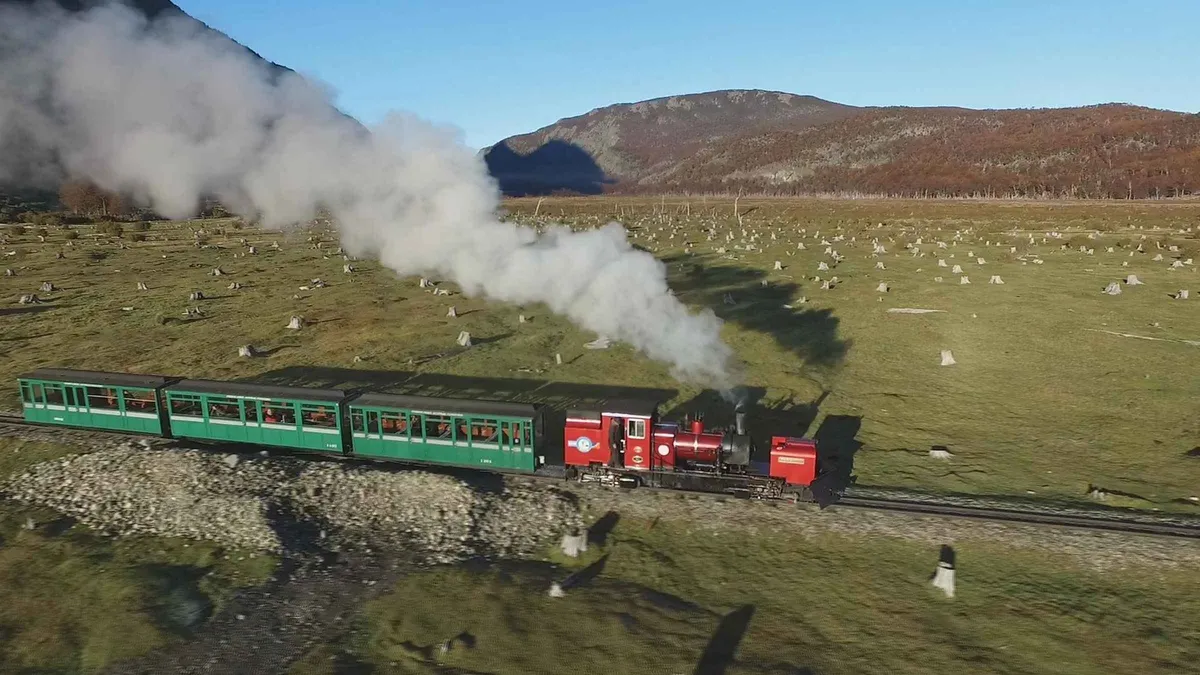
Top pick Ushuaia: National Park & Train of the End of the World Tour
The half-day pairing most visitors book: park viewpoints, the end-of-the-Panamerican-Highway sign and the End of the World Train ride, with hotel pickup. The cheapest way to tick off both icons in one morning or afternoon.
Check AvailabilityPrices, ratings and details are the platform's own. dollar figures are the listed prices — the platform bills in your account's currency.
On Foot
Ushuaia rewards walking more than any other mode for the town itself. The useful visitor map is small: a grid of maybe a dozen streets between the Beagle Channel waterfront and the first row of hills, and almost everything on a first-day list sits inside it.
What Is Walkable
Avenida San Martín is the spine. It runs the length of the commercial centre, one block up from the port, and carries most of the shops, tour agencies and cafes. From San Martín you reach Museo Marítimo at Yaganes y Gobernador Deloqui by the port, Museo del Fin del Mundo at Maipú 173 with its annex at Maipú 465, and the tourist office at San Martín 674.
The costanera runs along the water below, an easy flat promenade with the harbour on one side and the Martial mountains rising behind the roofs on the other. On a cruise day the cruise port puts you at the foot of this grid already, so arriving passengers can walk to the museums and the main street without any transport at all. For orientation on the ground, the city map marks these points.
The Hills Are Real
The town climbs. Each street going north from San Martín rises toward the Martial slopes, and some of the residential blocks climb steeply. This matters in two ways.
First, hotel choice changes your walking life: a hotel two blocks uphill from the port means a short climb at the end of every day. Our pick is to stay within a few blocks of San Martín if walking is your main mode, and the where to stay page sorts options by area. Second, walking downhill is easy and walking back up is not, so plan the day's direction accordingly.
Taxis are cheap and plentiful for the uphill leg, which locals use constantly.
Weather Decides the Day
Walking here is a weather activity. Averages from the 1995-2024 record put January highs at 12.3°C (54°F) and July highs at 1.0°C (34°F), with wind as the defining feature: average daily maximum winds run near 18 m/s in December and around 12 m/s in midwinter. Four seasons in one day is not a joke at this latitude, and a pleasant morning can turn to sleet by lunch.
Pack layers and a windproof shell even in summer. Daylight swings more than temperature: about 17 hours around the December solstice and about 7.5 hours around the June solstice, which in practice means summer walking days feel endless and winter walking days end before the museums do. The weather page carries the monthly detail and the best time to visit page weighs the trade-offs.
A Realistic Walking Day
As a shape, a car-free centro day looks like this. Morning at Museo Marítimo, which opens 10:00-20:00 daily with entry until 19:30 and a Spanish guided tour at 11:30, and whose ticket stays valid two days. Lunch on San Martín.
Afternoon at Museo del Fin del Mundo, open Monday to Friday 10:00-19:00 and Saturday 13:00-19:00, then the costanera toward the les Éclaireurs lighthouse views. Every step of that is flat or gently sloped. What walking cannot reach is anything on Ruta Nacional 3 or beyond, which is where the rest of this page takes over.
Sources: Museo Marítimo, Museo del Fin del Mundo and Infotur.
Taxis and Remises
Taxis are the workhorse of getting around ushuaia beyond the centre. They are everywhere in town, they take the airport run all day, and remis companies (radio-booked cars) handle the longer fixed trips. The honest caveat is that fares are not published anywhere official, so this section describes practice and reports rather than a rate card.
How the System Works
Two vehicle types serve the town. Taxis (black and yellow, or white with a roof sign depending on the era of the car) cruise the streets and can be hailed. Remises are remises, radio-dispatched cars you book by phone or through your hotel, common across Tierra del Fuego for fixed-price trips.
For a visitor the practical difference is small: hail on the street or ask your hotel to call, agree on the figure before you get in for anything beyond a metered-style centro hop, and pay cash in pesos. Card acceptance in taxis should not be assumed. The tourist office at San Martín 674 (phone +54 2901 432001, open daily roughly 8:30-20:30) can confirm current practice if something feels off.
Fares: What No Official Page Publishes
No official page publishes a taxi fare table for Ushuaia. That is a plain negative finding and the single most useful fact on this subject: there is no rate card to quote, and any specific fare you read online, including on this site, is a report rather than an official figure. What the sources do state is distance.
The airport is about 7 km from the centre and the standard run takes 10-15 minutes by taxi, which travellers treat as a roughly flat trip fare in practice (reported). For the 11 km ride to the national park gate, taxis work alongside the shuttles, and the same is true for the 7-8 km ride to the End of the World Train station, though remember the station sits inside the park so the mandatory park entry applies regardless of how you arrive. Agree the price before setting off for any of these longer runs.
Night rides follow the same pattern, with fewer cars cruising after the restaurants close, so a hotel call-out becomes the normal method rather than street hailing. For a sense of how transport fits into a day's budget, the costs page carries the overall picture.
Apps and Uber: Reported, Not Guaranteed
Ride-hailing apps are patchy in Ushuaia (reported). Uber in particular has no guarantee of working reliably here the way it does in Buenos Aires, and we will not state that it does. The safe planning assumption for getting around ushuaia is the old system: your legs in the centre, your hotel's phone for a remis, and a flagged taxi on the street at other times.
If you arrive by air with no Spanish and no pesos, the airport taxi desk is the fallback and the airport page covers arrival in detail.
Sources: Infotur, Secretaría de Turismo de Ushuaia and the airport operator.
City Buses and the Shuttle Reality
This is the section that saves people from a wasted morning. Ushuaia has city buses, and they are close to useless for visitors. What fills the gap is a shuttle minibus system aimed squarely at the national park and the train station, and it works well once you know where it leaves from.
Lines A to D Are for Commuters
The city bus lines A, B, C and D serve residential neighbourhoods, connecting the outer barrios with the centre at commuter times. They are not a visitor network. No line reaches the national park, the trailheads, the ski resort or the estancias, and frequency and routing are built around school and work hours rather than museum and trail hours.
A visitor trying to bus to the park gate will fail. Plan the days outside the centre around the options below instead, and keep the buses out of your calculations entirely.
The Park Shuttle From Maipú & Juana Fadul
The standard public way into Tierra del Fuego National Park is the shuttle minibus service, signed as Transporte Regular, which leaves from the corner of Maipú & Juana Fadul in the centre, daily roughly 8:00-20:00. It drops inside the park and returns on a set pattern through the day. The fare situation is worth stating carefully: no published fare exists.
Recent visitor reports put the round trip at ARS 16,000-28,000 ($10.61-$18.57), and that range, not a single number, is the honest figure. Carry pesos, expect to pay the driver or a desk at the corner, and treat any lower or higher quote you are given as within the reported band. Remember the park itself charges entry separately: the foreign visitor daily pass is ARS 40,000 ($26.50), with a 50% second-day discount within 72 hours on web tickets only, and children 0-6 and several resident categories free. The park tickets page walks through buying entry.
Hours matter too, since the park gate runs December to February 8:00-21:00, March and October to November 8:00-20:00, and April to September 9:00-18:00, so a winter shuttle day ends early.
Shuttle 3 and the Train Station
The End of the World Train leaves from Estación del Fin del Mundo at Ruta Nacional 3 km 8 (Presidente Alfonsín 4800), about 7-8 km west of town inside the national park. A shuttle service known as Shuttle 3 serves the station area (reported), running from town out Route 3 to the station for train departures. The train itself departs 9:30, 12:00 and 15:00 between September and April, and 9:45, 12:15 and 15:00 from May to August, with check-in 45 minutes before and seats released if you have not checked in 10 minutes before departure.
Two facts decide whether the shuttle is your answer. First, the station is inside the park, so the mandatory park entry applies on top of the train ticket, which the railway states explicitly. Second, if you want the park viewpoints as well as the ride, a combined tour removes two transfers. The National Park and End of the World Train tour handles pickup, the park circuit and the train for $49.50 in 5 hours, and the train page covers the fares and classes in full.
The comparison table of the tickets page is where the entry options sit side by side.
Which Shuttle Day Suits You
A quick comparison of the scheduled-transport options beyond town, using the figures above and the reported band where no official fare exists, so you can match cost to independence.
| Option | Goes to | Cost | Schedule |
|---|---|---|---|
| Park shuttle minibus | Park gate and stops inside the park | Reported ARS 16,000-28,000 ($10.61-$18.57) round trip, no published fare | Daily roughly 8:00-20:00 from Maipú & Juana Fadul |
| Shuttle 3 (reported) | Train station area on Route 3 | Not stated | Tied to train departures |
| Taxi or remis | Anywhere, including park and airport | No published fares, agree before boarding | On demand |
| Tour with pickup | Park, train, lakes or estancia circuits | From $49.50 for the park and train half day | Fixed departures, pickup confirmed at booking |
Sources: Parques Nacionales tariff and access information and Infotur.
Rental Cars
A rental car in Ushuaia is not for the town. It is for the two or three long days a road-based itinerary wants: Estancia Harberton to the east, the lakes and Garibaldi Pass to the north, and Cerro Castor in snow season. Rent for those days only and walk or taxi the rest.
When a Car Is Worth It
Run the arithmetic against the table at the top of this page. If your whole trip is the centre plus the national park, a car loses to the shuttle and a taxi every time, because the park day is short, the shuttle is reported at ARS 16,000-28,000 ($10.61-$18.57) round trip, and parking adds friction to a walkable town. The car earns its keep when you want the far map.
Estancia Harberton sits 85 km east, which is a full day by road with stops. The lakes route to Escondido and Fagnano runs north over Garibaldi Pass, the same corridor the 4x4 day tours use. Cerro Castor is 26 km out on Route 3, practical by car in the July to September ski season when the adult day pass runs about ARS 146,700 ($97.30).
Our pick for most trips of three to five days: skip the car entirely, book one or two tours for the far days, and spend nothing on parking. If you are building a longer loop, the day trips page shows what the guided versions cost before you commit to driving them yourself.
The Gravel Truth for Harberton
The road east toward Estancia Harberton is gravel for much of its length, which shapes both the car you rent and the day's timing. Allow the full day, drive to the conditions, and expect the dust and washboard that come with Fuegian gravel. Harberton opens 11 October to March, roughly 12:00-19:00, with guided house tours mid-afternoon and Museo Acatushún tours at fixed times, and its entry fee is repriced by season with no figure published outside its booking system, so check estanciaharberton.com before you drive.
The same road corridor serves the penguin colony boats that launch from the Harberton area, which is why so many visitors see it from a tour bus instead of their own car. Note also that walking among the penguins on Isla Martillo is only permitted with licensed operators, so a private car cannot substitute for the landing tour itself.
Fuel, Roads and the Winter Tyre Question
Fuel is available in Ushuaia town, and stations thin out fast beyond it, so fill before any long day. The trunk road is Ruta Nacional 3, running west to the park and train station and north over the Garibaldi Pass toward Tolhuin and the Atlantic side of the island. Weather closes options quickly here: the same record that shows January highs of 12.3°C (54°F) shows July highs of 1.0°C (34°F), and winter brings snow and ice to Route 3's higher sections.
On winter tyres, no official page we checked states a requirement or a guarantee for Ushuaia rentals, so ask the rental desk directly and get the answer in writing, because this is exactly the kind of fact that no published source settles for you. If the answer is no, do the snow-season days as tours instead, where the operator's vehicle carries the risk. Night driving adds a second reason to plan daylight-only legs, given roughly 7.5 hours of daylight around the June solstice.
Sources: Estancia Harberton, Cerro Castor and Infotur.
Do and Do Not
The transport habits that separate a smooth Ushuaia trip from a frustrating one, drawn from the fares, distances and schedules above.
Do
- Walk the centro. San Martín, the costanera and both museums need no transport at all.
- Use the Maipú & Juana Fadul shuttle corner for the national park, daily roughly 8:00-20:00.
- Carry pesos for taxis, shuttles and small desks, and assume cards will not work in a taxi.
- Agree taxi fares before boarding for anything beyond a centro hop, since no official fare table exists.
- Budget the park entry separately: ARS 40,000 ($26.50) for foreign visitors, on top of any transport.
- Book the far days (Harberton, the lakes, the ski resort) as tours or rental car days, never as bus days.
Don't
- Do not plan any visitor route around city bus lines A to D. They are commuter services.
- Do not count on Uber or app-based rides working reliably in Ushuaia. Reports are patchy.
- Do not drive to Estancia Harberton on an afternoon whim. It is 85 km on gravel and the estancia opens roughly 12:00-19:00 in season.
- Do not arrive at the train station without park entry. The station sits inside the park and entry is mandatory.
- Do not leave the rental car fuel top-up until the last minute. Stations thin out beyond town fast.
Five Things to Know Before You Move
A short list of the facts most likely to change your plan, each with its official source, so you can verify any of them yourself.
One. The city has no visitor bus. Lines A to D connect residential barrios with the centre at commuter times, and no line serves the park, the trailheads or the ski resort.
Every beyond-town day needs a shuttle, a taxi or a tour.
Two. The park shuttle fare is not published anywhere official. The reported round trip runs ARS 16,000-28,000 ($10.61-$18.57) from the Maipú & Juana Fadul corner, and park entry at ARS 40,000 ($26.50) for foreign visitors is always separate.
Treat both numbers as figures to verify at the desk on the day.
Three. The distances are short but the modes are few. The airport is 7 km out, 10-15 minutes by taxi.
The train station is 7-8 km west but inside the park. Cerro Castor is 26 km. Harberton is 85 km and mostly gravel.
Only the first two are casual taxi rides.
Four. Daylight is a transport variable. About 17 hours around the December solstice and about 7.5 hours around the June solstice mean summer days fit three activities and winter days fit one, and the park's own closing time drops to 18:00 from April to September.
Five. If the logistics feel like the trip rather than the support of the trip, hand them over. The National Park and End of the World Train tour puts park, train and pickup in one 5-hour booking, and the wider market is compared on the tours page.
Sources: Parques Nacionales, End of the World Train, aeropuertoushuaia.com, Infotur Ushuaia and Museo Marítimo.
Getting Around Map
The map marks the transport points that matter: the taxi ranks around the centre, the shuttle corner at Maipú & Juana Fadul, the tourist pier where channel boats leave, and the airport. Only the town-centre coordinate is published in our sources, so the in-town pins sit at that position and the airport is described rather than pinned, since its exact coordinates are not stated in the facts we checked.
Pages That Pair With This One
Transport planning connects to three other pages on this site. Each covers a piece of the same journey.
Ushuaia Airport
The arrival and departure end of every taxi conversation. Airlines, the Buenos Aires route and the 10-15 minute transfer.
7 km from the centreDay Trips From Ushuaia
The long days a rental car or tour bus exists for: the lakes route, Harberton and the king penguins.
26 km to 85 km outTierra del Fuego National Park
The destination the shuttle system was built for, with trails, the train station and the end-of-the-route sign.
11 km westGetting Around Ushuaia: Questions
Is Ushuaia walkable without a car?
The town centre is. Avenida San Martín, the costanera, Museo Marítimo and Museo del Fin del Mundo all sit inside a compact grid, with the main cost being the uphill blocks north of San Martín. Anything on Ruta Nacional 3 or beyond needs a shuttle, taxi or tour.
Is there a city bus to Tierra del Fuego National Park?
No. City lines A to D are commuter routes for residents and none serves the park. The standard visitor option is the shuttle minibus from Maipú & Juana Fadul, daily roughly 8:00-20:00, reported at ARS 16,000-28,000 ($10.61-$18.57) round trip with no published fare. Taxis and tours also work.
How much is a taxi from Ushuaia airport to the centre?
No official fare table exists, so no exact figure can be quoted. The airport is about 7 km from the centre and the run takes 10-15 minutes, and travellers report it as a roughly flat trip fare. Agree the price before boarding and carry pesos.
Does Uber work in Ushuaia?
App-based ride-hailing is patchy in Ushuaia (reported) and there is no guarantee of an Uber working the way it does in larger Argentine cities. Plan on street-hailed taxis, hotel-booked remises and the shuttle corner instead.
Do I need a rental car in Ushuaia?
Only for the far days. Harberton at 85 km (much of it gravel), the northern lakes route and Cerro Castor at 26 km are the drives that justify one. For the centre, the park and the airport, walking, the shuttle and taxis are cheaper and simpler. Our pick for short trips is no car at all.
How do I get to the End of the World Train station?
The Estación del Fin del Mundo sits at Ruta Nacional 3 km 8, about 7-8 km west of town inside the national park, so the mandatory park entry applies on top of the train ticket. Options are a taxi, the shuttle serving the station area (reported) or a tour. Trains leave 9:30, 12:00 and 15:00 from September to April, with check-in 45 minutes before.
Videos on Moving Around Ushuaia
Three videos from travel channels that show the town's scale and the practical reality of its streets, useful for judging the walking distances before you arrive.
USHUAIA TRAVEL GUIDE 🛳️ Things to do in USHUAIA, Argentina 🇦🇷 The City at the End of the World! 🐧🔭
A full orientation to the town on foot, useful for seeing how close the port, San Martín and the museums really are.
Video: Samuel and Audrey - Travel and Food Videos15 USHUAIA TRAVEL TIPS! Don’t travel before watching this video!
Practical tips including transport and planning habits for a town with no visitor bus network.
Video: Travel Tips GroupEnd of The World City! What to Do In Ushuaia Argentina Trip Itinerary
An itinerary view of the town and its excursions, helpful for matching transport modes to each day type.
Video: Hobarts Abroad - Sumner & AliWe may earn a commission if you book through one of our links, at no extra cost to you. Full affiliate disclosure